Yi temple with wall paintings
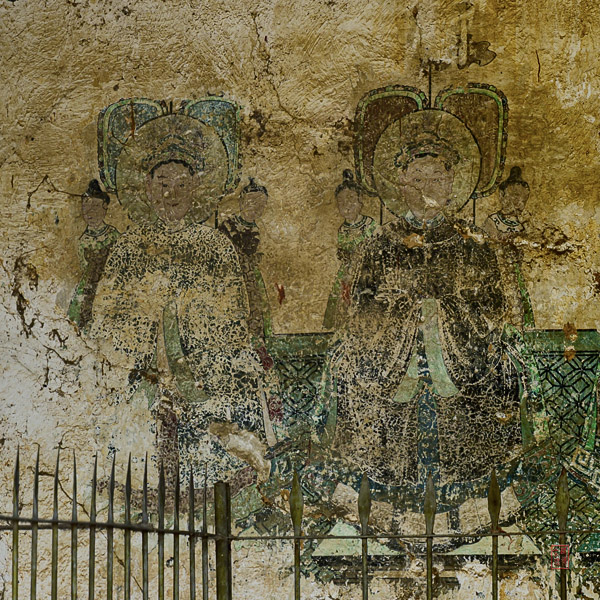
The Luose Temple, situated on a hillock that was once an island in Yilong Lake, was built in 1845 (the 25th year of the Daoguang reign of the Qing) to commemorate the hereditary native sub-prefect (土知州) and Yi chieftain Ma Henu 马赫奴, who died in battle at the end of the Ming leading his people against outside ethnic forces attempting to seize the area around Yilong Lake. The murals were created in 1846 (the 26th year of the Daoguang reign), comprising nine wall panels in total; the murals run 16.96 meters in overall length and 2 meters in height. Their content is divided into three parts — "Setting Out on Campaign" (出师), "Resisting the Enemy" (拒敌), and "Triumphant Return" (凯旋) — painted from left to right in the format of a sequential narrative picture-cycle. The compositions were first outlined in spare, economical ink line-work, then filled in with mineral pigments including malachite green, cinnabar red, and ochre. The scenes are grand in scale with numerous figures, each rendered with distinct, lifelike facial features. The paintings were covered with lime during the Cultural Revolution and thus at least partly survived. They are praised for their depiction of dress and armour from the period.