Even in the depth of winter, life in a Dai village does not truly slow down—it merely changes its rhythm.
Morning fog lingers long over the fields of Manglao 芒老, a small Dai settlement in Menglian, near the southwestern edge of Yunnan. When the mist finally thins, it reveals small fields of pale earth and stubbled plots, resting between harvests. This is the quiet season, far from the lush greens and standing water of spring and summer, yet it is anything but idle. Manglao lies within the administrative orbit of Puer, and only a short distance from the border with Burma, a location that has long shaped both livelihoods and anxieties.
Here in Manglao, the mountains begin to rise, limiting the size of the fields between the mountains, yet still allowing growing wet-rice, still the staple but not today not the only cash crop anymore. The better fields are on the main plain, where the county town lies only a few kilometres away, its glowing buildings clearly visible at night. Going up the mountains, life becomes harder as there is hardly any flat land: this is where the county's Lahu and Wa communities live. By most measures, the Dai villages are wealthier than their upland neighbours, their houses more spacious and the roads are better. Yet in winter, when the land lies bare, prosperity feels muted.
At the heart of Manglao, the small Buddhist temple remains the most carefully maintained structure, its clean lines and fresh paint standing out against the subdued winter palette. Nearby lies the Zhaixin 寨心, the symbolic center of the village. Here, tradition feels fragile. A lone crooked tree rises from a patchwork of cracked tiles, offering little shade and less ceremony. Maybe the villagers will rebuild the space properly one day, perhaps in the style of the neighbouring village of Mangyang 芒养, if funds can be gathered and priorities align.
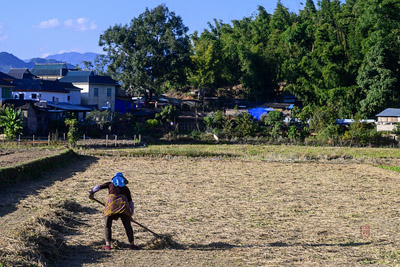
Early January finds only scattered activity in the fields. A few villagers comb the soil for overlooked coriander, careful not to waste anything that might still be sold or eaten. In another plot, a woman gathers rice straw, later to be burned so its ash can return nutrients to the earth. Elsewhere, thin green rice seedlings push upward beneath sheets of plastic, protected from cold nights and morning fog. These seedlings are the promise of the coming season; before the Spring Festival, they will be transplanted by hand into flooded paddies, and the plain will slowly transform from brown to green.
Despite the persistence of manual labor, signs of mechanisation are everywhere. Small tractors idle at the edges of fields, ready to level and prepare the soil so that the fields can be flooded and transplanting begin. Even in plots too narrow for large machines, engines now handle tasks that once demanded long days of backbreaking work. Inside the village, winter labor shifts indoors: groups of women sit together sorting peanuts, another important cash crop. Conversation flows easily as hands move quickly, blending social life with economic necessity.
In recent years, coffee has come to dominate the local economy, reshaping both landscapes and schedules. December is the busiest month, when ripe coffee cherries are harvested and processed. This season, villagers say the price—nine yuan per pound of beans—is acceptable, if not generous. It is enough to sustain families, pay for extensions of their houses, education for their children and the growing number of cars.
A fading slogan painted on a wall hints at troubles that lie beneath the surface calm: 不让毒品进我家—“Don't let drugs enter my home.” Manglao's proximity to the Burmese border has long exposed the region to drug trafficking routes that are difficult to control. While stricter border enforcement during the COVID years reportedly reduced smuggling, the continued presence of drug checkpoints on major highways suggests the problem has not disappeared. The slogan stands as both warning and hope, a reminder that the challenges facing the village are not only agricultural or economic, but deeply social as well.
Winter in Manglao is thus a season of contrasts: quiet fields and busy hands, modest means and careful pride, uncertainty and preparation. Beneath the fog and the pale soil lies a community waiting—not passively, but attentively—for spring to return and set the land, and life, in motion once again.
Slideshow
Click to see more